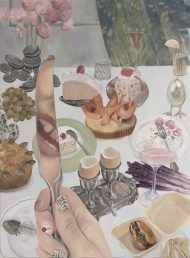
Autothéorie et noirceur
Je m’appelle Camille Kingué, je suis une autrice basée à Paris. Dans cette présentation, je souhaite interroger la notion de noirceur — et plus largement celle de race — dans le champ de l’autotheorie.
My name is Camille Kingué, and I am a writer based in Paris. In this presentation, I wish to examine the concept of blackness — and, more broadly, that of race — within the field of autotheory.
Mon intervention s’appuie principalement sur ma lecture de Autotheory as Feminist Practice in Art, Writing, and Criticism de Lauren Fournier, publié par MIT Press en 2022. Cet ouvrage constitue aujourd’hui l’un des travaux les plus importants consacrés à l’autotheory -le terme étant apparu récemment dans le champ universitaire, Lauren Fournier le fait coïncider avec 2015 et la parution des Argonautes de Maggie Nelson- et sera donc mon principal point de départ. Je précise d’emblée que mes recherches sur le sujet sont encore récentes : cette présentation est ainsi en grande partie une lecture critique de Fournier, à partir de laquelle je tenterai de faire émerger certaines questions qui me semblent rester en suspens.
My talk draws primarily on my reading of Lauren Fournier’s Autotheory as Feminist Practice in Art, Writing, and Criticism, published by MIT Press in 2022. This book is currently one of the most significant works on autotheory – a term that has only recently emerged in academic circles; Lauren Fournier traces its origins to 2015 and the publication of Maggie Nelson’s *The Argonauts* – and will therefore serve as my main point of departure. I should point out from the outset that my research on the subject is still in its early stages: this presentation is therefore largely a critical reading of Fournier’s work, from which I shall attempt to raise certain questions that seem to me to remain unresolved.
Il me faut tout d’abord définir ce que l’on entend par « autotheory ». Dans une sous-section de son introduction intitulée « Defining Autotheory », Lauren Fournier écrit :
First of all, I need to define what is meant by ‘autotheory’. In a sub-section of her introduction entitled ‘Defining Autotheory’, Lauren Fournier writes:
“Le terme “autotheory” est apparu au début du XXIe siècle pour désigner des œuvres de littérature, d’écriture et de critique qui intègrent l’autobiographie à la théorie et à la philosophie de manière directe et consciente.¹”
L’autotheory désigne donc des pratiques qui font de l’expérience personnelle et du corps des lieux de production de pensée. En faisant entrer le personnel, l’intime et le subjectif dans des espaces traditionnellement associés à la théorie, ces pratiques remettent en question certaines conceptions dominantes de la connaissance, notamment celles fondées sur la rationalité, l’objectivité et la distance entre le sujet qui pense et l’objet qu’il étudie.
Ces critères ne sont évidemment pas neutres. Ils ont historiquement contribué à légitimer certaines formes de discours et certaines figures du sujet théorique — notamment un sujet autonome, rationnel, désincarné et universalisé, historiquement associé à la pensée occidentale blanche et masculine — tout en disqualifiant les expériences et les savoirs qui ne correspondent pas à cette définition.
L’un des enjeux fondamentaux de l’autotheory est précisément de contester cette séparation entre la pensée et l’expérience, entre le sujet et son corps, entre le personnel et le théorique.
Autotheory therefore refers to practices that treat personal experience and the body as sites of thought production. By bringing the personal, the intimate and the subjective into spaces traditionally associated with theory, these practices challenge certain dominant conceptions of knowledge, particularly those based on rationality, objectivity and the distance between the thinking subject and the object they study.
These criteria are, of course, not neutral. Historically, they have helped to legitimise certain forms of discourse and certain figures of the theoretical subject — notably an autonomous, rational, disembodied and universalised subject, historically associated with white, male Western thought — whilst dismissing experiences and forms of knowledge that do not fit this definition.
One of the fundamental challenges of autotheory is precisely to challenge this separation between thought and experience, between the subject and their body, and between the personal and the theoretical.
Comme l’indique le titre de son ouvrage, Lauren Fournier inscrit cette pratique dans une histoire féministe. Mais elle reconnaît également explicitement la dimension raciale et coloniale de ce déplacement. Elle écrit notamment :
As the title of her book suggests, Lauren Fournier situates this practice within a feminist history. But she also explicitly acknowledges the racial and colonial dimensions of this shift. In particular, she writes:
“Une partie de la dimension politique de ce tournant autothéorique dans la culture pourrait bien résider dans le fait que les personnes BIPOC, les femmes, les personnes femmes [femme], les personnes trans et les personnes qui ne se conforment pas aux normes de genre associent leur travail à la théorie afin d’en souligner la puissance et la portée critiques. (...) — ce qui pourrait remettre en question les politiques de la lisibilité et de l’intelligibilité dans la “théorie”, en tant que discours historiquement eurocentré, américano-centré, masculiniste et colonial. ²”
La critique de la rationalité et de l’universalisme ne relève donc pas uniquement de la pensée féministe. Elle traverse également de nombreuses traditions intellectuelles noires et décoloniales qui ont interrogé la construction du sujet occidental, les conditions de production du savoir et les exclusions constitutives de la philosophie occidentale. On pourrait penser, entre autres, à Frantz Fanon avec Peau noire, masques blancs ou encore à Achille Mbembe avec Critique de la raison nègre.
Fournier elle-même consacre d’ailleurs le premier chapitre de son ouvrage à Adrian Piper, artiste conceptuelle et philosophe noire dont la pratique articule précisément les questions de race, de genre, de philosophie et d’expérience personnelle. Le chapitre, intitulé « Performing Kant: Surviving Philosophy through Self-Imaging », fait notamment référence à Food for the Spirit (1971), performance qui donne également lieu à une série photographique dans laquelle Piper jeûne, pratique le yoga et lit la Critique de la raison pure d’Emmanuel Kant dans une perspective critique où elle mesure la dichotomie entre son corps de femme racialisée et l’abstraction proposée par le philosophe.
Il serait donc injuste de dire que la race est absente de l’analyse de Fournier. Les questions de classe, de sexualité, de genre et de race sont présentes dans son ouvrage. Les corps noirs et racisés y sont convoqués, et leur présence participe même à la généalogie que Fournier construit de l’autotheory.
The critique of rationality and universalism is therefore not confined to feminist thought alone. It also runs through numerous Black and decolonial intellectual traditions that have scrutinised the construction of the Western subject, the conditions under which knowledge is produced, and the exclusions inherent in Western philosophy. One might think, amongst others, of Frantz Fanon’s Black Skin, White Masks or Achille Mbembe’s Critique of Black Reason.
Fournier herself, moreover, devotes the first chapter of her book to Adrian Piper, a Black conceptual artist and philosopher whose practice specifically articulates issues of race, gender, philosophy and personal experience. The chapter, entitled ‘Performing Kant: Surviving Philosophy through Self-Imaging’, refers in particular to Food for the Spirit (1971), a performance that also gave rise to a photographic series in which Piper fasts, practises yoga and reads Immanuel Kant’s Critique of Pure Reason from a critical perspective, examining the dichotomy between her body as a racialised woman and the abstraction proposed by the philosopher.
It would therefore be unfair to say that race is absent from Fournier’s analysis. Issues of class, sexuality, gender and race are present in her work. Black and racialised bodies are brought into the discussion, and their presence even contributes to the genealogy of autotheory that Fournier constructs.
Pourtant, si Fournier reconnaît dès le début de son ouvrage que l’autotheory peut constituer une pratique de contestation d’une théorie historiquement eurocentrée, masculine et coloniale, pourquoi le titre de son livre met-il en avant la dimension « féministe » de l’autotheory plutôt que sa dimension également décoloniale ? Et que révèle cette absence sur la manière dont la catégorie d’autotheory s’est constituée ?
Yet, whilst Fournier acknowledges from the outset of her book that autotheory can constitute a practice of challenging a historically Eurocentric, masculine and colonial theory, why does the title of her book emphasise the ‘feminist’ dimension of autotheory rather than its equally decolonial dimension? And what does this absence reveal about the way in which the category of autotheory has been constituted?
Je ne souhaite pas répondre à cette question en affirmant simplement que Fournier aurait « oublié » la race. Le problème me semble plus structurel. L’hypothèse que j’avance est que la catégorie d’autotheory demeure en partie organisée autour d’une conception blanche du sujet, de l’écriture de soi et de la production de savoir, y compris lorsqu’elle cherche explicitement à inclure des pratiques et des subjectivités non blanches.
Autrement dit, la présence de la noirceur dans un corpus ne suffit pas nécessairement à défaire la blanchité des catégories à partir desquelles ce corpus est pensé.
C’est cette tension que je voudrais examiner au travers de mon intervention.
I do not wish to answer this question by simply asserting that Fournier has ‘overlooked’ race. The problem seems to me to be more structural. My hypothesis is that the category of autotheory remains, in part, organised around a white conception of the subject, of writing about oneself and of the production of knowledge, even when it explicitly seeks to include non-white practices and subjectivities.
In other words, the presence of Blackness within a corpus is not necessarily sufficient to dismantle the whiteness of the categories through which that corpus is conceptualised.
It is this tension that I would like to examine in my presentation.
Lauren Fournier s’inscrit dans un champ de pensée où la noirceur a historiquement été structurellement exclue, tout en étant régulièrement convoquée comme objet de réflexion. Or cette convocation ne garantit pas pour autant son intégration pleine et entière dans les catégories théoriques qui organisent le champ. Pour comprendre ce paradoxe, il me semble nécessaire de remonter en amont de l’autotheory elle-même et de s’interroger sur l’histoire de l’écriture de soi.
Lauren Fournier operates within a field of thought where Blackness has historically been structurally excluded, whilst at the same time being regularly invoked as a subject of reflection. However, this invocation does not in itself guarantee its full and complete integration into the theoretical categories that organise the field. To understand this paradox, I believe it is necessary to go back to the origins of autotheory itself and to examine the history of writing about the self.
Car, écrire sur soi suppose déjà une certaine conception du « soi ». Cela suppose qu’un sujet puisse se penser comme sujet, qu’il puisse être reconnu comme producteur de savoir et que son expérience puisse être considérée comme un matériau légitime pour produire de la théorie. Or ces conditions sont historiquement et politiquement situées.
Qui sont les corps qui ont été pensés comme des sujets souverains ? Qui a historiquement été autorisé à produire de la théorie à partir de sa propre expérience ? Et, plus spécifiquement, à qui est-il accordé de produire de la nouveauté, de participer à l’avant-garde, de transformer son expérience en théorie et de faire de son « je » un lieu de connaissance ?
For writing about oneself already presupposes a certain conception of the ‘self’. It presupposes that a subject can conceive of themselves as a subject, that they can be recognised as a producer of knowledge, and that their experience can be regarded as legitimate material for producing theory. Yet these conditions are historically and politically situated.
Which bodies have been conceived as sovereign subjects? Who has historically been authorised to produce theory based on their own experience? And, more specifically, who is granted the right to produce something new, to participate in the avant-garde, to transform their experience into theory, and to make their ‘I’ a site of knowledge?
Ces questions me semblent d’autant plus importantes que l’autotheory est une catégorie récente, qu’il faut distinguer de l’autobiographie et de l’autofiction. Son apparition ne signifie pas que les pratiques qu’elle désigne sont nouvelles. Elle signifie plutôt qu’à un moment donné, certaines pratiques d’écriture ont été rassemblées sous une nouvelle catégorie. Il faut donc également se demander qui a le pouvoir de produire ces catégories, et quelles généalogies littéraires et théoriques elles rendent visibles ou invisibles.
C’est à partir de cette question que je vais également mettre en pratique la méthode autothéorique elle-même. Puisque l’autotheory consiste notamment à faire de l’expérience personnelle un lieu de production de pensée, je parlerai de ma propre expérience d’autrice noire évoluant dans un milieu littéraire queer et blanc. Je chercherai à comprendre ce que signifie écrire sur soi depuis cette position et pourquoi certaines formes d’écriture de soi produites par des corps noirs peuvent demeurer difficilement visibles ou lisibles dans le champ de l’autotheory.
Mais je chercherai tout au long de l’article à déplacer cette expérience personnelle vers une histoire plus longue de la littérature et de l’avant-garde. Si l’absence ou la faible visibilité des corps noirs dans le champ de l’autotheory ne relève pas uniquement de mon expérience individuelle, elle doit pouvoir être replacée dans une histoire des mécanismes de catégorisation et de canonisation littéraires. Je m’appuierai notamment sur les cas de Maggie Nelson, de Gloria Anzaldúa et de Semiotext(e).
Et enfin, je reviendrai à la question du sujet. Il s’agira d’interroger la spécificité de la subjectivité noire et de voir comment celle-ci peut entrer en tension avec une certaine conception du sujet héritée de la pensée occidentale blanche. Je chercherai notamment à comprendre pourquoi certaines formes d’intériorité et d’écriture de soi produites par des auteur·ices noir·es peuvent être difficiles à appréhender pour une théorie littéraire elle-même historiquement impliquée dans la constitution des canons.
These questions strike me as all the more important given that ‘autotheory’ is a recent category, one that must be distinguished from autobiography and autofiction. Its emergence does not mean that the practices it denotes are new. Rather, it means that, at a certain point in time, certain writing practices were grouped together under a new category. We must therefore also ask who has the power to produce these categories, and which literary and theoretical genealogies they render visible or invisible.
It is on the basis of this question that I shall also put the autotheoretical method itself into practice. Since autotheory consists, in particular, of turning personal experience into a site for the production of thought, I shall speak of my own experience as a Black author navigating a queer and white literary milieu. I shall seek to understand what it means to write about oneself from this position and why certain forms of self-writing produced by Black bodies may remain difficult to see or read within the field of autotheory.
However, throughout this article, I shall endeavour to situate this personal experience within a broader history of literature and the avant-garde. Whilst the absence or low visibility of Black bodies within the field of autotheory is not solely a matter of my individual experience, it must be contextualised within a history of the mechanisms of literary categorisation and canonisation. I shall draw in particular on the cases of Maggie Nelson, Gloria Anzaldúa and Semiotext(e).
Finally, I shall return to the question of the subject. The aim will be to examine the specificity of Black subjectivity and to explore how this may come into tension with a certain conception of the subject inherited from white Western thought. In particular, I shall seek to understand why certain forms of interiority and self-writing produced by Black authors may be difficult to grasp for a literary theory that is itself historically implicated in the constitution of canons.
Mon propos ne sera donc pas de démontrer que l’autotheory serait intrinsèquement blanche, ni de reprocher à Lauren Fournier de ne pas avoir suffisamment intégré les auteur·ices noir·es à son analyse. Il s’agira plutôt de comprendre ce que la difficulté à penser pleinement la noirceur à l’intérieur de cette catégorie révèle de l’histoire du sujet, de l’écriture de soi et de la théorie elle-même.
En ce sens, je voudrais partir d’un paradoxe : l’autotheory se donne pour projet de faire entrer le corps, l’expérience et l’intime dans la théorie ; mais quels corps, quelles expériences et quelles intériorités sont historiquement reconnus comme capables de produire de la théorie ?
My aim is therefore not to demonstrate that autotheory is intrinsically white, nor to criticise Lauren Fournier for failing to incorporate Black authors sufficiently into her analysis. Rather, the aim is to understand what the difficulty in fully conceptualising Blackness within this category reveals about the history of the subject, of self-representation and of the theory itself.
In this sense, I would like to begin with a paradox: autotheory sets out to bring the body, experience and the inner self into theory; but which bodies, which experiences and which inner worlds are historically recognised as capable of producing theory?
Lorsque j’ai effectué une recherche Google avec les mots « Black » et « autothéorie », l’une des premières occurrences qui est apparue était un article de Tope Folarin intitulé « Can a Black novelist write autofiction? ». Formulé sous la forme d’une question, l’article était sous-titré : « Why is the hottest literary trend of the last decade so blindingly white? » Il semblait faire écho à mes propres réflexions. Tope Folarin est écrivain, et cet article a été écrit en réaction à la réception de son premier roman, A Particular Kind of Black Man.
Dans cet article, Folarin observe que lorsque des écrivain·es racisé·es produisent des œuvres relevant de l’écriture de soi, celles-ci sont souvent qualifiées d’« autobiographiques » plutôt que d’« autofictionnelles ». Il est important de préciser que Folarin ne parle pas d’autotheory : son article porte exclusivement sur l’autofiction. Je mobilise néanmoins son analyse parce que la distinction qu’il met en évidence entre autobiographie et autofiction me semble pouvoir être transposée, à un degré encore plus fort, à la distinction entre autobiographie et autotheory.
De fait, l’autotheory entretient des liens étroits avec l’autofiction, même si les deux pratiques ne se confondent pas.
When I carried out a Google search using the terms ‘Black’ and ‘autotheory’, one of the first results that appeared was an article by Tope Folarin entitled ‘Can a Black novelist write autofiction?’. Formulated as a question, the article was subtitled: ‘Why is the hottest literary trend of the last decade so blindingly white?’ It seemed to echo my own reflections. Tope Folarin is a writer, and this article was written in response to the reception of his first novel, A Particular Kind of Black Man.
In this article, Folarin observes that when writers of colour produce works that fall within the realm of self-writing, these are often described as ‘autobiographical’
’ rather than ‘autofictional’. It is important to note that Folarin is not discussing autotheory: his article focuses exclusively on autofiction. Nevertheless, I draw on his analysis because the distinction he highlights between autobiography and autofiction seems to me to be applicable, to an even greater extent, to the distinction between autobiography and autotheory.
Indeed, autotheory has close links with autofiction, even though the two practices are not one and the same.
“l’autothéorie semble entretenir des liens particulièrement étroits avec l’autofiction, au point que les frontières entre les deux pratiques deviennent parfois poreuses. Tandis que l’autofiction explore les effets de brouillage entre réalité et fiction à partir d’un « je » instable, l’autothéorie engage souvent ce même « je » dans une visée critique, réflexive ou politique explicite.³”
Dans les deux cas, l’expérience singulière n’est donc pas seulement rapportée : elle devient le lieu d’une opération formelle ou intellectuelle.
C’est précisément cette différence de statut que met en lumière Folarin.
In both cases, therefore, the singular experience is not merely recounted: it becomes the site of a formal or intellectual operation.
It is precisely this difference in status that Folarin highlights.
L’autobiographie tend à être associée à une fonction documentaire ou testimoniale : elle donne accès à l’expérience d’un sujet et à une histoire singulière. L’autofiction, au contraire, est souvent valorisée pour sa capacité à déplacer les frontières du récit de soi et à produire une forme nouvelle. L’autotheory pousse encore plus loin ce déplacement, puisqu’elle revendique explicitement la capacité du sujet à transformer son expérience en objet de réflexion et en production théorique.
À cela s’ajoute le fait que l’autotheory se constitue dans un espace particulier, à l’intersection de la littérature, de l’art contemporain et de l’université contrairement à l’autofiction et à l’autobiographie qui relèvent exclusivement du littéraire. Fournier écrit ainsi :
Autobiography tends to be associated with a documentary or testimonial function: it provides access to a subject’s experience and to a singular history. Autofiction, by contrast, is often valued for its ability to shift the boundaries of self-narrative and to produce a new form. Autotheory takes this shift even further, since it explicitly asserts the subject’s capacity to transform their experience into an object of reflection and theoretical production.
Added to this is the fact that autotheory is situated within a specific space, at the intersection of literature, contemporary art and academia, unlike autofiction and autobiography, which belong exclusively to the literary sphere. Fournier writes:
“L'« autothéorie » semble être le terme qui décrit le mieux les pratiques des artistes, des écrivains et des autres acteurs du monde de l'art et de la culture qui évoluent à la croisée de l'art contemporain, de la littérature et du monde universitaire. ⁴”
L’enjeu n’est donc pas seulement une différence entre trois genres littéraires. Ces catégories correspondent également à des statuts différents accordés au sujet qui écrit.
À certains sujets est plus facilement reconnue une capacité de raison, d’abstraction et de rupture avec la tradition. À d’autres, leur parole demeure davantage associée à l’expérience, au témoignage ou à l’histoire dont ils seraient les représentants.
Dans son article, Folarin décrit précisément cette différence. Son roman est lu comme un immigrant novel ou un bildungsroman, alors qu’il affirme l’avoir écrit sous l’influence de l’autofiction.
Pour lui, cette différence n’est pas anodine. Lorsqu’un critique mobilise le terme « autofiction », écrit-il, il suggère qu’un écrivain participe à la création d’un nouveau type de littérature. À l’inverse, l’expression « autobiographical fiction » renverrait à une œuvre qui s’inscrit dans une tradition déjà constituée.
Autrement dit, la question n’est pas simplement : qui écrit ?
Elle est aussi : qui est reconnu comme produisant quelque chose de nouveau ?
The issue, therefore, is not merely a difference between three literary genres. These categories also correspond to different statuses accorded to the writer.
Certain writers are more readily recognised as possessing the capacity for reason, abstraction and a break with tradition. For others, their voice remains more closely associated with experience, testimony or the history of which they are seen as representatives.
In his article, Folarin describes this difference precisely. His novel is read as an ‘immigrant novel’ or a ‘bildungsroman’, whilst he claims to have written it under the influence of autofiction.
For him, this distinction is not insignificant. When a critic uses the term ‘autofiction’, he writes, they suggest that a writer is helping to create a new type of literature. Conversely, the term ‘autobiographical fiction’ would refer to a work that forms part of an already established tradition.
In other words, the question is not simply: who is writing?
It is also: who is recognised as producing something new?
C’est ici que le concept d’« epistemic agency » développé par la philosophe Kristie Dotson me semble particulièrement utile.
Dans son article « Conceptualize Epistemic Oppression », elle écrit :
It is here that the concept of ‘epistemic agency’ developed by the philosopher Kristie Dotson strikes me as particularly useful.
In her article ‘Conceptualise Epistemic Oppression’, she writes:
“Epistemic oppression refers to persistent epistemic exclusion that hinders one’s contribution to knowledge production. Epistemic exclusion, here, will be understood as an unwarranted infringement on the epistemic agency of knowers. Epistemic agency, in this analysis, refers to the ability to utilize persuasively shared epistemic resources within a given community of knowers in order to participate in knowledge production and, if required, the revision of those same resources.⁵”
La notion d’« epistemic agency » permet ici de déplacer légèrement la question. Il ne s’agit plus seulement de demander si un sujet peut produire du savoir, mais s’il dispose de la capacité d’intervenir dans les catégories au moyen desquelles son expérience est transformée en connaissance.
Autrement dit : peut-il seulement raconter son expérience, ou peut-il également contribuer à définir les formes sous lesquelles cette expérience sera reconnue comme théorie, comme littérature ou comme innovation ?
The concept of ‘epistemic agency’ allows us here to reframe the question slightly. It is no longer simply a matter of asking whether a subject can produce knowledge, but whether they have the capacity to intervene in the categories through which their experience is transformed into knowledge.
In other words: can they merely recount their experience, or can they also help to define the forms in which that experience will be recognised as theory, literature or innovation?
C’est à partir de cette question que je voudrais revenir à l’histoire de l’autotheory. Si l’entrée de l’expérience personnelle dans la théorie a permis à certaines femmes de contester leur exclusion du champ théorique, il faut également se demander quelles femmes ont été reconnues comme capables d’effectuer ce déplacement et, plus largement, quels sujets ont été autorisés à transformer leur expérience en forme nouvelle et donc, à créer un nouveau paradigme.
Deux exemples me semblent particulièrement révélateurs : celui de Maggie Nelson et Gloria Anzaldúa, et celui de la maison d’édition Semiotext(e), figure majeur dans le champ de l’autothéorie. Ces deux exemples sont notamment étudiés par Lauren Fournier.
Le premier concerne la manière dont se construisent les généalogies littéraires (qui participent à l’élaboration des nouvelles normes ?). Dans un article publié sur le blog de Ploughshares en mai 2016, Daniel Peña affirme que The Argonauts de Maggie Nelson est un descendant direct de Borderlands/La Frontera de Gloria Anzaldúa.
Je cite :
It is from this question that I would like to return to the history of autotheory. Whilst the incorporation of personal experience into theory has enabled certain women to challenge their exclusion from the theoretical field, we must also ask which women have been recognised as capable of effecting this shift and, more broadly, which subjects have been permitted to transform their experience into a new form and thus to create a new paradigm.
Two examples strike me as particularly revealing: those of Maggie Nelson and Gloria Anzaldúa, and that of the publishing house Semiotext(e), a major figure in the field of autotheory. These two examples are examined in particular by Lauren Fournier.
The first concerns the way in which literary genealogies are constructed (who contributes to the development of new norms?). In an article published on the Ploughshares blog in May 2016, Daniel Peña asserts that Maggie Nelson’s The Argonauts is a direct descendant of Gloria Anzaldúa’s Borderlands/La Frontera.
I quote:
“To separate Anzaldúa from the wider canon (and subsequently from those books she influenced) is to ignore her contribution to American literature. It’s to say she doesn’t belong in that sort of highbrow conversation, which she so obviously does—even Nelson acknowledges that she does. People always wonder how the erasure of Chicana/o literature occurs in the contemporary era, and I’d argue it happens in much the same way. The omission of writers of colour from the broader literary dialogue is just as violent as silencing them.⁶”
L’enjeu soulevé par Peña ne concerne donc pas uniquement la présence ou l’absence d’Anzaldúa dans mais dans la manière dont celle-ci n’est pas pensée comme canon. Il concerne la place qui lui est attribuée dans l’histoire de l’innovation littéraire. The Argonauts est régulièrement présenté comme un texte fondateur de ce qui sera ensuite appelé « autotheory », notamment parce que le terme apparaît explicitement sur sa couverture. Peña rappelle pourtant que le livre de Nelson s’inscrit dans une généalogie qui comprend Borderlands/La Frontera, ouvrage publié près de trois décennies auparavant et qui articule déjà expérience personnelle, théorie, philosophie, poésie et réflexion sur l’identité et dont Maggie Nelson reconnait elle-même l’influence.
The issue raised by Peña therefore does not concern merely the presence or absence of Anzaldúa, but rather the fact that she is not regarded as part of the canon. It concerns the place accorded to her in the history of literary innovation. *The Argonauts* is regularly presented as a seminal text of what would later be termed ‘autotheory’, not least because the term appears explicitly on its cover. Peña points out, however, that Nelson’s book forms part of a lineage that includes *Borderlands/La Frontera*, a work published nearly three decades earlier and which articulates already a blend of personal experience, theory, philosophy, poetry and reflection on identity, the influence of which Maggie Nelson herself acknowledges.
La question devient alors celle de l’attribution de l’innovation. Qui est reconnu comme l’origine d’une nouvelle forme ? Qui est reconnu comme ayant ouvert une voie ? Et qui, au contraire, est relégué à une position d’influence secondaire, alors même que son travail a contribué à rendre cette nouvelle forme possible ?
Comme le résume Fournier, Peña « laments the tendency for white writers to be credited with the coining of “new genres” that BIPOC writers and artists contributed to developing »⁷. Elle ajoute que Peña insiste sur « the violence of erasing Chicana literature from the lineage of American writing that Nelson’s “autotheory” draws from »⁸.
The question then becomes one of attributing innovation. Who is recognised as the originator of a new form? Who is recognised as having paved the way? And who, by contrast, is relegated to a position of secondary influence, even though their work helped to make this new form possible?
As Fournier summarises, Peña ‘laments the tendency for white writers to be credited with the coining of “new genres” that BIPOC writers and artists contributed to developing’⁷. She adds that Peña emphasises ‘the violence of erasing Chicana literature from the lineage of American writing that Nelson’s “autotheory” draws from’⁸.
Ce qui se joue ici est donc moins une absence qu’un problème de catégorisation. Comme l’a souligné Tope Folarin dans son article, ce n’est pas qu’il n’y a pas d’auteurs·rices racisé·es qui écrivent de l’autofiction -chose que nous pouvons aussi appliquer à l’autothéorie- mais plutôt que celleux qui en produisent ne sont pas lu·es comme tel·les en raison d’un biais racial. Ce qui est en jeu n’est pas seulement la présence ou l’absence d’une œuvre, mais la capacité à participer à la définition des catégories qui permettent de nommer cette œuvre.
Le cas de Semiotext(e) permet d’observer un mécanisme comparable – celui de la catégorisation des auteurs·rices selon leur inscription ou non dans le champ de la théorie et de l’innovation.
What is at stake here, therefore, is less an absence than a problem of categorisation. As Tope Folarin pointed out in his article, it is not that there are no racialised authors writing autofiction – something we can also apply to autotheory – but rather that those who produce it are not read as such due to racial bias. What is at stake is not merely the presence or absence of a work, but the ability to participate in defining the categories that enable that work to be named.
The case of Semiotext(e) allows us to observe a comparable mechanism – that of categorising authors according to whether or not they are situated within the field of theory and innovation.
Fondée en 1974 par Sylvère Lotringer alors qu’il était enseignant à l’université de Columbia, Semiotext(e) est d’abord un journal issu d’un groupe de discussion qu’il dirige à l’université. À partir des années 1980, une maison d’édition se développe et la collection « Foreign Agents », qui publie en anglais des textes de philosophes français tels que Jean Baudrillard, Michel Foucault ou Gilles Deleuze, est créée. Elle contribue ainsi à la diffusion aux États-Unis de ce qui sera ensuite désigné comme la « French Theory ».
Dans ce contexte, Chris Kraus, alors compagne de Sylvère Lotringer, performeuse, cinéaste et autrice, propose en 1990 la création d’une nouvelle collection, « Native Agents ». Elle y publie notamment des textes de Kathy Acker, Cookie Mueller ou Eileen Myles. Fournier montre que cette collection de “fiction” -en opposition à la collection “théorie” uniquement composée d’hommes- constitue un espace important pour l’émergence d’une écriture expérimentale féministe, queer et théoriquement informée.
Elle écrit :
Founded in 1974 by Sylvère Lotringer whilst he was a lecturer at Columbia University, Semiotext(e) began as a journal stemming from a discussion group he led at the university. From the 1980s onwards, a publishing house developed, and the ‘Foreign Agents’ series— which published texts by French philosophers such as Jean Baudrillard, Michel Foucault and Gilles Deleuze in English—was launched. It thus contributed to the dissemination in the United States of what would later be termed ‘French Theory’.
Against this backdrop, Chris Kraus – then Sylvère Lotringer’s partner, a performance artist, filmmaker and writer – proposed in 1990 the creation of a new series, ‘Native Agents’. In it, she published works by Kathy Acker, Cookie Mueller and Eileen Myles, amongst others. Fournier demonstrates that this ‘fiction’ series – in contrast to the ‘theory’ series, which featured only male authors – provided a vital space for the emergence of experimental feminist, queer and theoretically informed writing.
She writes:
“The actions of male editors and writers precluding women, in different ways, from the terrain of “theory” have been ongoing. [...] Semiotext(e) played a role in publishing work that I find especially pertinent to the autotheorical impulse, and yet the press’s history and catalogue also show how stark gender divides persisted through poststructuralist and postmoder[n] theory: even the theory that purported to destabilize power hierarchies and to queer gender nonetheless remained dominated by cis male voices in ways that excluded others ⁹”
Cette distinction éditoriale est révélatrice. Même lorsqu’un espace s’ouvre pour des voix qui avaient été marginalisées dans le champ théorique, les catégories continuent d’organiser différemment les possibilités de reconnaissance. Fournier pose d’ailleurs directement la question : « Why was Semiotext(e) not publishing theory by women? »¹⁰ Elle rapporte une réponse de Kraus selon laquelle Lotringer était à l’aise avec la publication de textes écrits par des femmes lorsqu’il s’agissait de fiction, mais beaucoup moins lorsqu’il s’agissait de théorie.
Il faut cependant ajouter une dimension raciale à cette histoire. Fournier note que, malgré son caractère expérimental et féministe, « Native Agents » est demeurée une collection majoritairement blanche. Elle souligne que cette dimension a été prise en compte plus tard dans d’autres sous-collections, qui ont notamment publié des auteur·ices comme Jackie Wang ou Veronica Gonzalez Pena.
Ce point me semble particulièrement important : l’accès des femmes au champ de la théorie ne signifie pas nécessairement que toutes les femmes y accèdent de la même manière.
This editorial distinction is revealing. Even when a space opens up for voices that had been marginalised within the theoretical field, categories continue to organise the possibilities for recognition in different ways. Fournier, moreover, poses the question directly: ‘Why was Semiotext(e) not publishing theory by women?’¹⁰. She reports a response from Kraus to the effect that Lotringer was comfortable publishing texts written by women when they were works of fiction, but far less so when they were theoretical works.
However, a racial dimension must be added to this story. Fournier notes that, despite its experimental and feminist nature, ‘Native Agents’ remained a predominantly white series. She emphasises that this dimension was taken into account later in other sub-series, which notably published authors such as Jackie Wang and Veronica Gonzalez Pena.
This point strikes me as particularly important: women’s access to the field of theory does not necessarily mean that all women gain access to it in the same way.
Le cas de Semiotext(e) permet précisément d’observer cette différenciation en matière de statut. En 1993, une troisième collection, « Active Agents », est créée afin de publier des auteur·ices dont les textes sont explicitement politiques (il serait d’ailleurs intéressant d’interroger la notion de “politique”). Parmi les premiers ouvrages publiés figurent notamment ceux de Dhoruba Bin Wahad, Assata Shakur et Mumia Abu-Jamal, presque seul·es auteurs·rices Noir·es du catalogue.
Je ne veux évidemment pas suggérer que la maison d’édition aurait consciemment assigné les auteur·ices noir·es à une catégorie politique et militante. Mais la répartition du catalogue permet de poser une question : lorsque des auteur·ices noir·es entrent dans cette histoire éditoriale, sous quelles catégories sont-iels rendu·es visibles ?
The case of Semiotext(e) allows us to observe precisely this differentiation in terms of status. In 1993, a third series, ‘Active Agents’, was launched to publish authors whose texts are explicitly political (it would, incidentally, be interesting to examine the notion of ‘politics’). Among the first works published were those by Dhoruba Bin Wahad, Assata Shakur and Mumia Abu-Jamal, who were almost the only Black authors in the catalogue.
I certainly do not wish to suggest that the publishing house consciously assigned Black authors to a political and activist category. But the organisation of the catalogue raises a question: when Black authors enter this publishing history, under which categories are they made visible?
catégories du politique, du militantisme ou de l’histoire que par celles de l’expérimentation formelle et de l’innovation théorique. Autrement dit, leur écriture risque davantage d’être lue comme une prise de parole depuis une condition historique et sociale particulière que comme une intervention dans les formes mêmes de la littérature ou de la théorie.
Cette distinction fait écho à l’analyse de Folarin. Dans son cas, son roman est lu comme un « immigrant novel » ou un bildungsroman, alors qu’il affirme l’avoir écrit sous l’influence de l’autofiction. Dans les deux cas, le problème n’est donc pas nécessairement l’absence d’une pratique, mais la catégorie à travers laquelle cette pratique est lue et reconnue.
categories of politics, activism or history rather than those of formal experimentation and theoretical innovation. In other words, their writing is more likely to be read as a voice speaking from a particular historical and social condition than as an intervention in the very forms of literature or theory.
This distinction echoes Folarin’s analysis. In his case, his novel is read as an ‘immigrant novel’ or a bildungsroman, whilst he claims to have written it under the influence of autofiction. In both cases, therefore, the problem is not necessarily the absence of a practice, but the category through which that practice is read and recognised.
C’est ici que la question de la blanchité me semble devoir être pensée non comme une essence, mais comme une position relationnelle.
La blanchité désigne ici moins un phénotype qu’une position dans une configuration sociale donnée : une position susceptible de donner accès à certaines institutions, à certains réseaux, à certaines formes de légitimité et, dans le cas qui m’intéresse ici, à certaines manières d’être reconnu comme producteur de théorie ou d’innovation.
It is here that the question of whiteness, it seems to me, must be conceived not as an essence, but as a relational position.
Whiteness here denotes less a phenotype than a position within a given social configuration: a position capable of granting access to certain institutions, certain networks, certain forms of legitimacy and, in the case that interests me here, certain ways of being recognised as a producer of theory or innovation.
C’est dans ce sens que j’emploie le terme lorsque je parle de Chris Kraus.
It is in this sense that I use the term when I speak of Chris Kraus.
Il ne s’agit pas de réduire son identité à une catégorie raciale unique, ni de nier les spécificités de sa judéité, mais de réfléchir à sa position dans des espaces institutionnels et culturels historiquement structurés par des normes blanches dans lesquelles elle a évolué : l’université de Columbia via Sylvère Lotringer, la scène artistique new-yorkaise ou encore les réseaux de l’avant-garde littéraire américaine.
La blanchité est donc ici envisagée comme une relation : être situé du côté de la blanchité signifie, dans une configuration donnée, occuper une position qui donne accès à certaines ressources, à certaines formes de légitimité et à certains codes de reconnaissance.
Tope Folarin montre d’ailleurs que cette blanchité peut fonctionner comme un ensemble de codes culturels.
Dans son article, les œuvres d’auteur·ices racisé·es, Tao Lin et Teju Cole, qui sont qualifiées d’autofiction mettent en scène des personnages évoluant dans des contextes occidentaux urbains et mobilisant des références culturelles associées à une certaine forme de capital culturel.
This is not a matter of reducing her identity to a single racial category, nor of denying the specificities of her Jewishness, but of reflecting on her position within institutional and cultural spaces historically structured by white norms in which she developed: Columbia University via Sylvère Lotringer, the New York art scene, and the networks of the American literary avant-garde.
Whiteness is therefore viewed here as a relationship: being situated on the side of whiteness means, within a given context, occupying a position that affords access to certain resources, certain forms of legitimacy and certain codes of recognition.
Tope Folarin also demonstrates that this whiteness can function as a set of cultural codes.
In his article, the works of writers of colour, Tao Lin and Teju Cole—which are described as autofiction—feature characters navigating urban Western contexts and drawing on cultural references associated with a certain form of cultural capital.
“Writers of colour are rarely featured in discussions of autofiction. Indeed, the two writers of colour who are consistently mentioned amongst autofiction’s practitioners— Teju Cole and Tao Lin—use characters whose lives and concerns are likely to be understood by most members of the literary critical establishment. The protagonist of Lin’s "Taipei" is a writer named Paul who lives in Brooklyn and is on a book tour to promote his second novel. The first few pages of "Open City", Cole’s debut novel, feature the protagonist, Julius, rattling off a dizzying number of Western artists and thinkers—including Ludwig van Beethoven, Richard Wagner, Rodion Shchedrin, Eugène Ysaÿe, Roland Barthes, Peter Altenberg, and St Augustine—and describing his preference for classical radio stations from Canada, Germany, and the Netherlands (American stations, he says, ‘had too many adverts for my taste’). The effect is to signal to the reader that Julius is immersed in Western high culture, and that Western readers are entering a safe, well-appointed space in which their admiration for these same figures will be affirmed.¹¹”
Cette question me concerne également directement. Les institutions dans lesquelles j’ai étudié — classe préparatoire littéraire, EHESS, Sciences Po — ont constitué une partie importante de mon capital culturel et institutionnel. Il me semble que ces trajectoires ont également contribué aux conditions dans lesquelles mon propre travail a pu être publié et diffusé au sein de maisons d’édition au catalogue majoritairement blanc.
Autrement dit, être une autrice noire ne détermine pas à elle seule la manière dont une œuvre sera reçue. La position d’un sujet est toujours constituée par plusieurs rapports sociaux et plusieurs formes de capital. C’est précisément ce qui permet de penser la blanchité comme une relation plutôt que comme une identité fixe.
Cette dernière affirmation me paraît essentielle pour comprendre la place de la noirceur dans l’autotheory. Car si certains sujets sont plus facilement reconnus comme capables de transformer leur expérience en innovation formelle ou théorique, tandis que d’autres sont davantage renvoyés à leur histoire, à leur identité ou à leur condition sociale, alors l’enjeu n’est plus simplement celui de la représentation.
Il concerne l’autorité épistémique accordée au « je ».
This question also concerns me directly. The institutions at which I studied — the literary preparatory class, EHESS, Sciences Po — have formed a significant part of my cultural and institutional capital. It seems to me that these educational pathways have also contributed to the conditions under which my own work has been published and distributed by publishing houses with predominantly white catalogues.
In other words, being a Black author does not, in itself, determine how a work will be received. A subject’s position is always constituted by multiple social relations and multiple forms of capital. It is precisely this that allows us to conceive of whiteness as a relationship rather than as a fixed identity.
This final point strikes me as essential to understanding the place of Blackness in autotheory. For if some subjects are more readily recognised as capable of transforming their experience into formal or theoretical innovation, whilst others are more often reduced to their history, their identity or their social condition, then the issue is no longer simply one of representation.
It concerns the epistemic authority accorded to the ‘I’.
C’est à partir de cette question que je voudrais maintenant revenir à la subjectivité noire elle-même.
Que se passe-t-il lorsqu’un sujet historiquement constitué comme objet de savoir cherche à devenir le sujet de sa propre théorie ? Et que devient la possibilité même d’un « je » noir lorsqu’il entre dans une tradition intellectuelle qui a longtemps défini les conditions de reconnaissance du sujet à partir d’un universalisme blanc ?
L’autotheory se présente comme une pratique qui déstabilise la rationalité, l’objectivité et les formes traditionnelles de production du savoir. Mais sa généalogie institutionnelle demeure largement structurée par une conception du sujet capable d’autoréflexivité, d’abstraction et d’innovation.
It is from this question that I would now like to return to Black subjectivity itself.
What happens when a subject historically constituted as an object of knowledge seeks to become the subject of their own theory? And what becomes of the very possibility of a Black ‘I’ when it enters an intellectual tradition that has long defined the conditions for the subject’s recognition on the basis of white universalism?
Autotheory presents itself as a practice that destabilises rationality, objectivity and traditional forms of knowledge production. Yet its institutional genealogy remains largely structured by a conception of the subject capable of self-reflexivity, abstraction and innovation.
La question noire oblige donc à repenser non seulement qui pratique l’autotheory, mais aussi les conditions mêmes qui permettent de reconnaître une pratique comme autothéorique. La conception occidentale du « soi » autonome, transparent et réflexif sur laquelle repose une certaine tradition de l’autotheory est elle-même historiquement construite à travers l’exclusion de certains sujets.
Fournier pense l’autotheory comme une hybridation de l’expérience personnelle, de la théorie et de l’expérimentation formelle.
Mais que devient cette formule lorsque l’expérience personnelle elle-même est historiquement constituée par l’esclavage, la racialisation, la dépossession et la difficulté à être reconnu comme sujet souverain ?
The Black question therefore compels us to rethink not only who practises autotheory, but also the very conditions that allow a practice to be recognised as autotheoretical. The Western conception of the autonomous, transparent and reflexive ‘self’ upon which a certain tradition of autotheory is based is itself historically constructed through the exclusion of certain subjects.
Fournier conceives of autotheory as a hybridisation of personal experience, theory and formal experimentation.
But what becomes of this formulation when personal experience itself is historically constituted by slavery, racialisation, dispossession and the difficulty of being recognised as a sovereign subject?
C’est ici que À perte de mère de Saidiya Hartman me semble constituer un exemple particulièrement intéressant.
Hartman ne fait pas simplement « entrer son histoire personnelle dans l’histoire ». Elle découvre que son histoire personnelle est constituée par une histoire dont les archives ont précisément empêché la constitution d’un récit de soi stable.
Dans l’introduction du livre, Maboula Soumahoro écrit ceci :
It is here that Saidiya Hartman’s Losing My Mother strikes me as a particularly interesting example.
Hartman does not simply ‘bring her personal history into history’. She discovers that her personal history is constituted by a history whose archives have, in fact, prevented the formation of a stable self-narrative.
In the book’s introduction, Maboula Soumahoro writes:
“Hartman explore l’histoire autant qu’elle s’explore elle-même.¹²”
Tout au long de l’ouvrage, Saidiya Hartman met en balance ce qui relève du personnel et la manière dont celui-ci s’inscrit dans une histoire plus large : celle de l’esclavage et de la traite atlantique. À perte de mère, sous-titré Sur les routes atlantiques de l’esclavage, relate le voyage de l’autrice au Ghana, où elle se rend dans le cadre d’une recherche sur la traite esclavagiste.
Partir sur les traces de cette histoire devient aussi une manière de partir sur ses propres traces.
Hartman écrit :
Throughout the book, Saidiya Hartman balances the personal with the way in which it fits into a broader history: that of slavery and the Atlantic slave trade. In The Loss of a Mother, subtitled On the Atlantic Routes of Slavery, recounts the author’s journey to Ghana, where she travels as part of her research into the slave trade.
Setting out to trace this history also becomes a way of tracing her own history.
Hartman writes:
“Les trous, les silences et les pièces vides constituaient-elles l’essence principale de mon histoire ? ¹³”
Puis :
Then:
“J’étais noire et une histoire de terreur avait produit cette identité.¹⁴”
Et encore :
again:
“parfois, revenir en arrière et avancer se confondent.¹⁵”
Et enfin :
And finally:
“J’errais dans cette esclaverie non parce que j’espérais y découvrir ce qu’il s’était réellement passé, mais plutôt à cause de ce qui avait perduré de cette histoire. Pour quelle autre raison commencer une autobiographie dans un cimetière ? ¹⁶”
Ces phrases me semblent importantes parce qu’elles déplacent profondément la relation entre autobiographie, histoire et théorie. Chez Hartman, écrire « je » ne signifie pas simplement accéder à une intériorité déjà constituée et en faire la matière d’une réflexion. Le « je » apparaît au contraire comme quelque chose qu’il faut chercher à travers des archives lacunaires, des silences et des histoires de dépossession. L’écriture de soi devient alors aussi une écriture de l’impossibilité de se retrouver soi-même dans les archives.
C’est ici que la question du sujet noir rencontre celle de l’autotheory.
These sentences strike me as significant because they profoundly shift the relationship between autobiography, history and theory. For Hartman, writing ‘I’ does not mean simply to access an already established inner world and make it the subject of reflection. The ‘I’, on the contrary, appears as something that must be sought out through incomplete archives, silences and stories of dispossession. Writing about oneself thus also becomes a way of writing about the impossibility of finding oneself in the archives.
It is here that the question of the Black subject intersects with that of autotheory.
L’autotheory est censée permettre à des sujets marginalisés de produire du savoir à partir de leur expérience. Mais pour que cette opération soit reconnue comme telle, il faut que le sujet soit déjà reconnu comme :
● un sujet ;
● ayant une intériorité ;
● dont l’expérience peut produire du savoir ;
● capable d’abstraction ;
● capable d’innovation formelle.
Or l’histoire de la racialisation a précisément produit des formes de déni ou de limitation de cette reconnaissance. Il ne s’agit évidemment pas de dire que les sujets noirs n’ont pas d’intériorité, de capacité d’abstraction ou de capacité à produire de l’innovation. Il s’agit de comprendre que ces capacités n’ont pas historiquement bénéficié des mêmes conditions de reconnaissance.
Le problème devient alors celui de la grammaire même du « je ». Une certaine tradition occidentale du sujet autonome repose sur une conception de l’individu comme sujet propriétaire de lui-même, de son histoire, de son nom et de son intériorité.
Autotheory is supposed to enable marginalised subjects to produce knowledge based on their own experience. But for this process to be recognised as such, the subject must already be recognised as:
● a subject;
● possessing an inner life;
● whose experience can produce knowledge;
● capable of abstraction;
● capable of formal innovation.
Yet the history of racialisation has, precisely, produced forms of denial or limitation of this recognition. This is obviously not to say that Black subjects lack inner life, the capacity for abstraction or the capacity to produce innovation. It is a matter of understanding that these capacities have not, historically, enjoyed the same conditions of recognition.
The problem then becomes one of the very grammar of the ‘I’. A certain Western tradition of the autonomous subject is based on a conception of the individual as a subject who is the owner of themselves, their history, their name and their inner life.
L’histoire de l’esclavage vient profondément perturber cette architecture : le sujet noir a été juridiquement et socialement constitué comme objet de propriété, comme corps administré, nommé, déplacé et décrit par d’autres. Cela ne signifie pas que les subjectivités noires seraient dépourvues de continuité ou d’intériorité. Cela signifie que leur reconnaissance comme sujets souverains s’est historiquement construite contre des dispositifs qui les constituaient comme objets.
Dans ce contexte, le « je » noir ne peut pas être pensé simplement comme une intériorité autonome qui attendrait d’entrer dans la théorie. Il doit aussi être pensé comme une subjectivité relationnelle, historiquement produite, et parfois reconstruite à partir des traces d’une histoire qui a précisément empêché son archivage.
C’est pourquoi À perte de mère me paraît si important pour penser l’autotheory. Hartman ne se contente pas d’utiliser son expérience personnelle comme matériau théorique. Elle interroge les conditions historiques qui rendent cette expérience difficilement racontable.
Son « je » n’est donc pas seulement un instrument permettant d’entrer dans l’histoire. Il est lui-même le lieu où l’histoire devient problématique.
The history of slavery profoundly disrupts this framework: the Black subject was legally and socially constituted as an object of property, as a body administered, named, displaced and described by others. This does not mean that Black subjectivities lack continuity or inner life. It means that their recognition as sovereign subjects has historically been constructed in opposition to systems that constituted them as objects.
In this context, the Black ‘I’ cannot be conceived simply as an autonomous interiority waiting to be incorporated into theory. It must also be conceived as a relational subjectivity, historically produced, and sometimes reconstructed from the traces of a history that has, precisely, prevented its archiving.
This is why À perte de mère strikes me as so important for thinking about autotheory. Hartman does not merely use her personal experience as theoretical material. She interrogates the historical conditions that make this experience difficult to recount.
Her ‘I’ is therefore not merely an instrument for entering into history. It is itself the site where history becomes problematic.
Ainsi, cela me conduit à reformuler la question de départ. Il ne s’agit peut-être pas seulement de demander si la noirceur peut entrer dans l’autotheory. Il faut demander ce que la présence de la noirceur oblige à transformer dans la définition même du sujet autothéorique.
This, then, leads me to reformulate the initial question. Perhaps it is not merely a matter of a question of whether blackness can enter into autotheory. We must ask what the presence of blackness compels us to transform in the very definition of the autotheoretical subject.
Auteurice :
Camille Kingué, née en 1994. Vit et travaille à Paris. Camille Kingué a obtenu un Master en histoire de l’art à l’EHESS et un Master en management culturel à Sciences Po Paris. Son travail d’écriture se compose essentiellement de poèmes publiés dans des fanzines et des revues (Alei, Suckcess, The Tongue Ring). Membre du collectif How To Become (Paris), elle a publié avec elleux un premier recueil, Sex I en français et en anglais, et sa suite, Sex 2, en anglais, avec la maison de micro-édition If A Leaf Falls Press (Londres) et sa traduction française, Sexe 2, avec Dépense Défensive. Sexe 3, a été publié aux éditions Les Petits Matins dans la collection littéraire dirigée par Jérôme Mauche en août 2026. Elle traite principalement dans ses textes de l’intime, du corps et des affects tels que la mélancolie et la honte et s’intéresse à la façon dont les structures sociales traversent les individus. Elle est depuis janvier 2026 étudiante en 3e cycle dans la formation ACTH (Art Contemporain, Temps et Histoire) à l’Ecole Nationale Supérieure des Beaux-Arts de Lyon.
Camille Kingué, born in 1994. Lives and works in Paris. Camille Kingué earned a master’s degree in art history from EHESS and a master’s degree in cultural management from Sciences Po Paris. Her writing consists primarily of poems published in fanzines and magazines (Alei, Suckcess, The Tongue Ring). As a member of the How To Become collective (Paris), she published her first collection with them, Sex I in French and English, and its sequel, Sex 2 in English, with the micro-publisher If A Leaf Falls Press (London), as well as its French translation, *Sexe 2*, with Dépense Défensive. Sexe 3 was published by Les Petits Matins in the literary collection edited by Jérôme Mauche in August 2026. Her writing primarily explores intimacy, the body, and emotions such as melancholy and shame, and she is interested in how social structures shape individuals. Since January 2026, she has been a graduate student in the ACTH (Contemporary Art, Time, and History) program at the École Nationale Supérieure des Beaux-Arts de Lyon.
Notes Fr.
⁵ « L’oppression épistémique désigne l’exclusion épistémique persistante qui entrave la contribution d’un individu à la production de connaissances. L’exclusion épistémique sera ici comprise comme une atteinte injustifiée à l’autonomie épistémique des acteurs du savoir. Dans cette analyse, l’autonomie épistémique désigne la capacité à utiliser de manière convaincante les ressources épistémiques partagées au sein d’une communauté donnée d’acteurs du savoir afin de participer à la production de connaissances et, si nécessaire, à la révision de ces mêmes ressources. » – Kristie Dotson, ‘Conceptualising Epistemic Oppression’, Social Epistemology, vol. 28, no. 2, 2014, pp. 115–138, here p. 1 of the PDF. https://doi.org/10.1080/02691728.2013.782585
⁶ « Séparer Anzaldúa du canon littéraire au sens large (et, par conséquent, des ouvrages qu’elle a influencés), c’est ignorer sa contribution à la littérature américaine. C’est affirmer qu’elle n’a pas sa place dans ce genre de débat intellectuel, alors qu’elle y a manifestement sa place — même Nelson le reconnaît. On se demande toujours comment s’opère l’effacement de la littérature chicana/o à l’époque contemporaine, et je dirais que cela se passe à peu près de la même manière. L’omission des écrivains de couleur du dialogue littéraire général est tout aussi violente que le fait de les réduire au silence. » – Daniel Peña, ‘The Argonauts Is A Direct Descendant Of Anzaldúa’s Borderlands/La Frontera And No One Is Talking About It’, Ploughshares, 9 May 2016, https://pshares.org/blog/the-argonauts-is-a-direct-descendant-of-anzalduas-borderlandsla-frontera-and -no-one-is-talking-about-it/ (accessed 13 October 2026).
⁷ Lauren Fournier, *Autotheory as Feminist Practice in Art, Writing, and Criticism*, Cambridge (MA), MIT Press, 2021, p. 35.
⁸ ibid, p. 36
⁹ « Les pratiques des éditeurs et des auteurs masculins, qui excluent les femmes, de différentes manières, du domaine de la « théorie », se poursuivent depuis longtemps. […] Semiotext(e) a joué un rôle dans la publication d’ouvrages que je trouve particulièrement pertinents pour la démarche autothéorique ; pourtant, l’histoire et le catalogue de cette maison d’édition montrent également à quel point les clivages de genre ont persisté tout au long de la théorie poststructuraliste et postmoderne : même la théorie qui prétendait déstabiliser les hiérarchies de pouvoir et « queeriser » le genre restait néanmoins dominée par des voix d’hommes cisgenres, d’une manière qui excluait les autres. » – ibid, p. 55
¹⁰ ibid, p. 56
¹¹ « Les auteurs issus des minorités ethniques sont rarement mis en avant dans les débats sur l’autofiction. En effet, les deux auteurs issus des minorités ethniques régulièrement cités parmi les praticiens de l’autofiction — Teju Cole et Tao Lin — mettent en scène des personnages dont la vie et les préoccupations sont susceptibles d’être comprises par la plupart des membres de l’establishment de la critique littéraire. Le protagoniste de *Taipei* de Lin est un écrivain nommé Paul qui vit à Brooklyn et effectue une tournée promotionnelle pour son deuxième roman. Les premières pages de *Open City*, le premier roman de Cole, présentent le protagoniste, Julius, énumérant à toute vitesse une liste vertigineuse d’artistes et de penseurs occidentaux — dont Ludwig van Beethoven, Richard Wagner, Rodion Shchedrin, Eugène Ysaÿe, Roland Barthes, Peter Altenberg et saint Augustin — et décrivant sa préférence pour les stations de radio classiques du Canada, d’Allemagne et des Pays-Bas (les stations américaines, dit-il, « avaient trop de publicités à mon goût »). L’effet produit est de signaler au lecteur que Julius baigne dans la haute culture occidentale, et que les lecteurs occidentaux pénètrent dans un espace sûr et bien aménagé où leur admiration pour ces mêmes figures sera confirmée. » – Tope Folarin, ‘Can a Black Novelist Write Autofiction?’, The New Republic, 27 October 2020, https://newrepublic.com/article/159951/can-black-novelist-write-autofiction (accessed 13 October 2026).
Notes En. :
¹ »The term “autotheory” emerged at the beginning of the 21st century to describe works of literature, writing and criticism that integrate autobiography into theory and philosophy in a direct and conscious manne » -Lauren Fournier, Autotheory as Feminist Practice in Art, Writing, and Criticism, Cambridge (Massachusetts), The MIT Press, 2021, p. 7
² « Part of the political dimension of this autotheoretical shift in culture may well lie in the fact that BIPOC people, women, trans people and those who do not conform to gender norms associate their work with theory in order to highlight its critical power and scope. (…) — which could call into question the politics of legibility and intelligibility within ‘theory’, as a discourse that is historically Eurocentric, American-centric, masculinist and colonial » – Ibid., pp. 46–47
³ « Autotheory seems to have particularly close links with autofiction, to the extent that the boundaries between the two practices sometimes become blurred. Whilst autofiction explores the blurring of the lines between reality and fiction through an unstable ‘I’, autotheory often engages this same ‘I’ in an explicitly critical, reflexive or political endeavour » – ‘What to make of autotheory?’, Fabula, online: https://www.fabula.org/actualites/128465/que-faire-de-l-autotheorie.html (accessed 13 October 2026).
⁴ « Autotheory seems to best describe the practices of artists, writers and other art and culture workers who move between the worlds of contemporary art, literature and academia » – Lauren Fournier, *Autotheory as Feminist Practice in Art, Writing, and Criticism*, Cambridge (MA), MIT Press, 2021, p. 8.
¹² » Hartman explores history just as much as she explores herself » – Saidiya Hartman, *In Search of a Mother: On the Atlantic Routes of Slavery*, translated from the American English and with a foreword by Maboula Soumahoro, Montreuil, Brook, 2023, p. 13
¹³ « Were the gaps, the silences and the empty spaces the very essence of my story? » – ibid, p. 40
¹⁴ « I was Black, and a history of terror had shaped that identity. » – ibid, p. 76
¹⁵ « Sometimes, looking back and moving forward become one and the same. » – ibid, p. 160
¹⁶ « I wandered through that slavery not because I hoped to discover there what had really happened, but rather because of what had endured from that history. For what other reason would one begin an autobiography in a cemetery? » – ibid, p. 212